
- ✓Grab is the regional ride-hailing app and the simplest way to avoid haggling — it fixes the fare up front, maps the route and removes the language barrier, so it's the default for most visitors.
- ✓Metered taxis are fine value when the driver uses the meter — insist on it, and if they refuse or quote a flat fare, wave them on and take the next one or open Grab.
- ✓At the airport, ignore the touts in the arrivals hall offering a 'taxi'; use the official public-taxi queue or order a Grab from the designated ride-hail pickup point instead.
- ✓Songthaews — the shared pickup-truck taxis — are the cheap local backbone outside Bangkok; tuk-tuks are a negotiated, tourist-priced ride, so agree the fare before you climb in.
- ✓Fares, surcharges and which apps work where change by city and over time — let the app quote the price, and verify any flat fare against the meter before you commit.
Grab first — the app that takes the haggling out of it
If you remember one thing about getting around Thai towns, make it this: download Grab before you arrive. Grab is the dominant ride-hailing app across the region, and it solves the two problems that frustrate visitors most — the language barrier and the fare argument. You set your pickup and destination, the app shows the price before you book, a driver accepts, and you pay the agreed fare by card or cash with nothing to negotiate. In Bangkok it pulls in regular cars, registered taxis and motorbike taxis; in many other cities it works the same way, and in some places the rival app Bolt is a useful second option to compare.

Grab isn't always the cheapest option on paper — a metered taxi using its meter can come out lower, and a songthaew far lower — but it is the most predictable, and for a first-timer that certainty is worth a small premium. Use it especially when you don't speak the language, when you're arriving somewhere unfamiliar, late at night, or any time you'd rather not test a driver's honesty. Coverage and the exact fare vary by city and change over time, so let the in-app quote tell you the price rather than relying on a figure you read somewhere.


Metered taxis and the meter problem
Thailand's metered taxis — most visible in Bangkok as the bright multicoloured cars — are genuinely good value when the meter is running, often cheaper than the equivalent Grab. The catch is the all-too-common opening move: the driver refuses the meter and quotes a flat fare, usually well above what the meter would read, betting you don't know the difference. The fix is simple and not rude: ask for the meter as you get in, and if the driver won't use it or insists on a fixed price, simply decline and take the next taxi or open Grab. There's always another cab.
A few practical habits help. Have your destination written in Thai or pinned on a map to show the driver, carry small notes because change can be scarce, and be aware that on expressways the toll is added to your fare and is normal. Late at night and in the rain, flat-fare refusals get more common and a Grab is often the calmer choice. The principle throughout: you should be paying either the meter or an app-quoted price — a driver's made-up flat number is the one to walk away from.

Songthaews, tuk-tuks and the local rides
Outside Bangkok, the local modes take over and they're part of the fun. The songthaew — a converted pickup with two bench seats in the back — is the shared-taxi backbone of Chiang Mai, Phuket, Pattaya and most towns, and the cheapest way around. The red trucks of Chiang Mai run roughly like buses on flexible routes: you flag one down, tell the driver where you're going, and pay a few baht per person on arrival; they can also be hired privately for a higher agreed price. Knowing the rough local rate keeps you from overpaying.
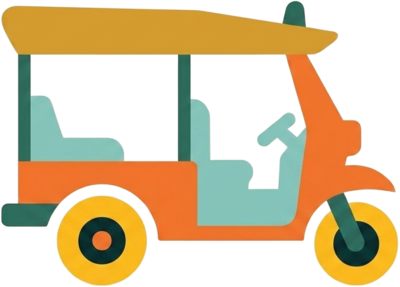
The tuk-tuk is the photogenic three-wheeler, faster through traffic and an experience in itself — but it has no meter and is priced for tourists, so it is always a negotiation. Agree the fare clearly before you climb in, and be wary of the classic too-cheap tuk-tuk that comes with a 'quick stop' at a gem shop or tailor where the driver earns a commission. For a straightforward A-to-B, a Grab is usually cheaper and simpler than a tuk-tuk; take the tuk-tuk when the ride is the point. Motorbike taxis — riders in numbered vests — are the fastest way through gridlock for solo, light-luggage hops, available both on the street and through Grab.
From the airport — the one place people overpay most
The arrivals hall is where first-timers lose the most money, because it's where the touts work. Anyone approaching you offering a 'taxi' or 'limousine' as you exit customs is almost always a fixed-fare middleman charging several times the real cost. Walk past them. At Bangkok's airports and the major regional ones, the right move is the official public-taxi queue — clearly signed, usually with a ticket dispenser, where you get a metered car — or ordering a Grab from the airport's designated ride-hail pickup point, which the app will direct you to.

A few airports add a small, legitimate airport surcharge to the metered fare, which is normal; the made-up flat quote from a hall tout is not. Where a rail link exists — Bangkok's Airport Rail Link from Suvarnabhumi is the classic — it's often the fastest and cheapest way into the city centre at rush hour, bypassing the traffic entirely. Decide your airport plan before you land, because that's the moment the touts count on you being tired and unsure. Verify the current taxi surcharge and the ride-hail pickup location for your specific airport, as both change.

Sources and official planning resources
Getting a ride · at a glanceAdmin FC
- Easiest
- Grab — fixed fare in-app, no haggling, card or cash; Bolt is a common alternative in some cities
- Best value
- Metered taxi when the meter is actually used — insist on it or take a Grab
- Cheapest local
- Songthaew (shared pickup taxi) on fixed routes outside Bangkok — a few baht a hop
- Tuk-tuk
- A negotiated, tourist-priced ride — agree the fare before you get in
- Airport
- Use the official public-taxi queue or the Grab pickup point — never the arrivals-hall touts
- Payment
- Grab takes card or cash; taxis and tuk-tuks are cash — carry small notes
- Verify first
- Fares, surcharges and app coverage vary by city — let the app quote, and check any flat fare against the meter


